Barber students invest $16,800+ into an education that prepares them physically but repeatedly fails them theoretically at the state licensing level.
A state-aware Sovereign RAG Pipeline calibrated to 50 individual state Candidate Information Bulletins.
Guaranteed first-time pass rates, protecting the $16K tuition risk and securing $5,000+ per candidate in recovered wage utility.
Artificial Domain Intelligence (ADI) that ingests state textbooks and auto-generates exam synthesis to combat structural informational dissonance.
Overcoming the Blockade: Barber Education Intelligence
A deeply researched validation into the state board written examination—the most damaging financial bottleneck in the barbering industry—and the Cognitive Intelligence architecture designed to completely eradicate it.
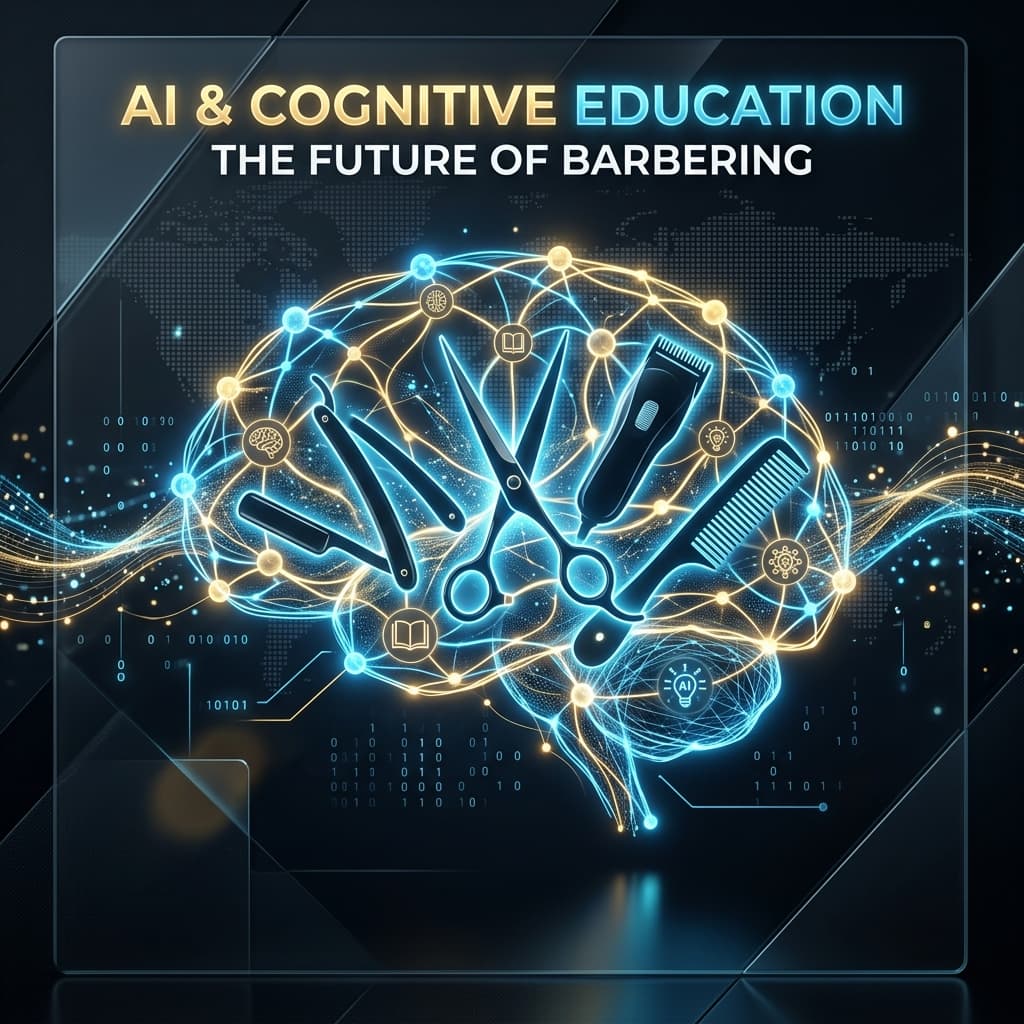
Architectural Hypothesis
This report examines the fragmentation of the United States barber licensure mechanism. Built on the premise of Artificial Domain Intelligence (ADI), this validates a proprietary education pipeline that scales across regulatory borders to close the gap between practical competence and theoretical testing fail rates.
01. The $16K Bottleneck: Physical Preparation vs. Cognitive Reality
The modern barbering education is a massive upfront capital commitment. Students in the United States invest an average of $14,980 in tuition and an additional $1,821 in books and supplies.[4] They commit anywhere from 1,000 to 1,500 hours standing behind the chair mastering the physical art of blending, fading, and straight-razor shaving.
But increasingly, the physical skill is not what stands between the student and a license. On January 1, 2022, the State of California—the largest beauty footprint in the nation—permanently removed the practical component of the barber state examination.[1] Licensure is now 100% reliant on a student's ability to pass an archaic written theory exam.
The combined sunk cost of tuition, supplies, and tools invested prior to taking the written licensure examination.
In major states like California, the test is no longer about clipper control—it's entirely about theoretical knowledge and test-taking syntax.
Historically, students pass the practical exams easily. The failure point has overwhelmingly trended toward the written examination.
Failing the written test induces a 1-to-3-month schedule backlog, effectively erasing thousands in potential early-career baseline revenue.
| Scenario | Path to License | Capital Lost | Est. Recovered Wage Utility |
|---|---|---|---|
| Legacy Textbooks | Fails Written (Wait 90 Days) | $150 Retest + $5K Wages | $0 |
| Flashcard Apps | Barely Passes (Possible 30 Day Lag) | High Test Anxiety | Baseline |
| ADI Intelligence Layer | Passes First Attempt (No Lag) | $0 | + $5,000+ |
* Modeled based on the $5K potential minimum wage lag suffered by a licensed barber missing 1-3 months of chair time due to exam backlog constraints.[5]
02. Informational Dissonance: Why Prepared Students Fail
Our research points to a major failure in structural information parity. The failure of state board students is rarely rooted in a lack of skill; the failure stems from informational dissonance and a misunderstanding of what is actually being tested.
Conflicting Source Texts (Milady vs. Pivot Point)
The two primary educational textbooks in the U.S. often provide contradictory statements on chemical pH levels and hygiene procedures. If a student is taught out of Milady but their state accesses test questions verified by Pivot Point, the student may answer correctly based on their training and still fail the question.
The Non-Core Chemical Dependency Trap
A barber student may intend to specialize purely in tight fades and beard grooming. Yet state exams aggressively test anatomical composition and chemical service theory (perms, relaxers, dye). Because this knowledge seems peripheral to the practical chair, it is neglected, despite comprising up to 30% of the exam weight.
03. The Generative Exam Engine & CIB Integration
When scaling AI Barber Education Intelligence across the U.S., a generic quiz app fails due to regulatory fragmentation. The true solution requires a **Sovereign Regulatory Brain** established through Retrieval-Augmented Generation (RAG).
The Artificial Domain Intelligence (ADI) fundamentally changes how students study through the precise vector ingestion of Candidate Information Bulletins (CIB).[2] By scraping and mapping the exact weights of the Texas exam vs. the New York exam, the engine creates synthetic study conditions perfectly mirroring reality.
Ingest and Clean
PDFs of textbooks, Administrative Codes, and State forms are processed via OCR and securely stored in the Data Lake, establishing immutable fidelity.
Atomic Fragmentation
The RAG pipeline chops textbooks into 'Knowledge Atoms.' The ADI maps out when information conflicts, establishing a hierarchical truth specifically geared to the target state board.
Dynamic Generation
Rather than forcing students to click through 10 static quizzes over and over, the system dynamically generates questions mapped exactly to the percentage weights disclosed in the CIB. Students encounter the tricky syntax that mimics real-world exam conditions.
"An ADI acts as the ultimate conflict resolver. When a Texas student queries a question on infection control algorithms, the AI filters out California laws and Milady contradictions, returning only what the TDLR evaluator is attempting to see."
Supported by: Texas TDLR Class A Barber licensing requirements and statistical trends indicating lack of theoretical preparedness in technical areas.[3]
04. The Institutional Reality: Accreditation Protection
While the student bears the immediate financial blow of exam failure, the existential risk is actually absorbed by the school. The National Accrediting Commission of Career Arts & Sciences (NACCAS) sets strict thresholds for academic viability. If an academy's licensure pass rate drops below 70%, they enter probationary statuses that severely threaten their accreditation.[6]
Without NACCAS accreditation, an institution can no longer accept federal financial aid (Title IV funding). For the majority of barber academies, the loss of Title IV equates to immediate insolvency. The Barber Education Intelligence pipeline transcends being a generic study tool—it operates as an institutional Accreditation Protection Engine. By leveraging the Sovereign RAG pipeline to guarantee pass rates, academy owners mathematically defend their primary revenue pipeline and secure their business valuation.
As hundreds of students cycle through the regional Generative Exam Engine, the ADI captures localized failure metrics at scale. Before a quarterly testing block, the ADI informs academy instructors that "82% of current enrollees are failing Infection Control syntax." It grants administration the ability to pivot the real-world curriculum proactively, ensuring the critical 70% threshold is never breached by utilizing predictive analytics rather than reactive failure autopsy.
05. The Sovereign Knowledge Advantage (Verdict)
There is a massive market opportunity in barber education. Academies consistently teach the correct physical skills necessary to earn a living, but fail to navigate the regulatory framework holding the keys to immediate post-grad monetization.
When the ultimate outcome of a $16,800 education relies 100% on a candidate's ability to answer theoretical questions correctly during a high-stakes exam, schools must upgrade their educational deployment vehicles.
Institutions that augment their training curriculum with AI Education Intelligence will practically guarantee passing credentials to their enrollees, vastly outperforming schools utilizing static testing software or generalized ChatGPT prompts. The architecture to deploy this is fully sovereign, secure, and state-specific.
Research References
California Board of Barbering & Cosmetology (2021). Senate Bill 803: Practical Examination Removal Notice. CA.gov / DCA. Visit Source
National Interstate Council of State Boards of Cosmetology (NIC) (2024). Barber Candidate Information Bulletins (CIB). NIC Testing. Visit Source
Texas Department of Licensing and Regulation (TDLR) (2023). Examination Statistics: Class A Barber. TDLR.texas.gov. Visit Source
CollegeTuitionCompare (2024). Average Barbering / Cosmetology Tuition Costs in the US. CollegeTuitionCompare.com. Visit Source
GlossGenius Industry Insights (2023). State of the Grooming Industry: Economic Impact resulting from Testing Backlogs. GlossGenius. Visit Source
National Accrediting Commission of Career Arts & Sciences (NACCAS) (2024). Standards and Criteria for Institutional Accreditation. NACCAS.org. Visit Source
Secure Your Students'
Licensure Guarantee
Connect your curriculum with our state-calibrated ADI and ensure your tuition leads directly to post-grad employment. Overcome the $16K testing blockade starting today.
Deploy Intelligence