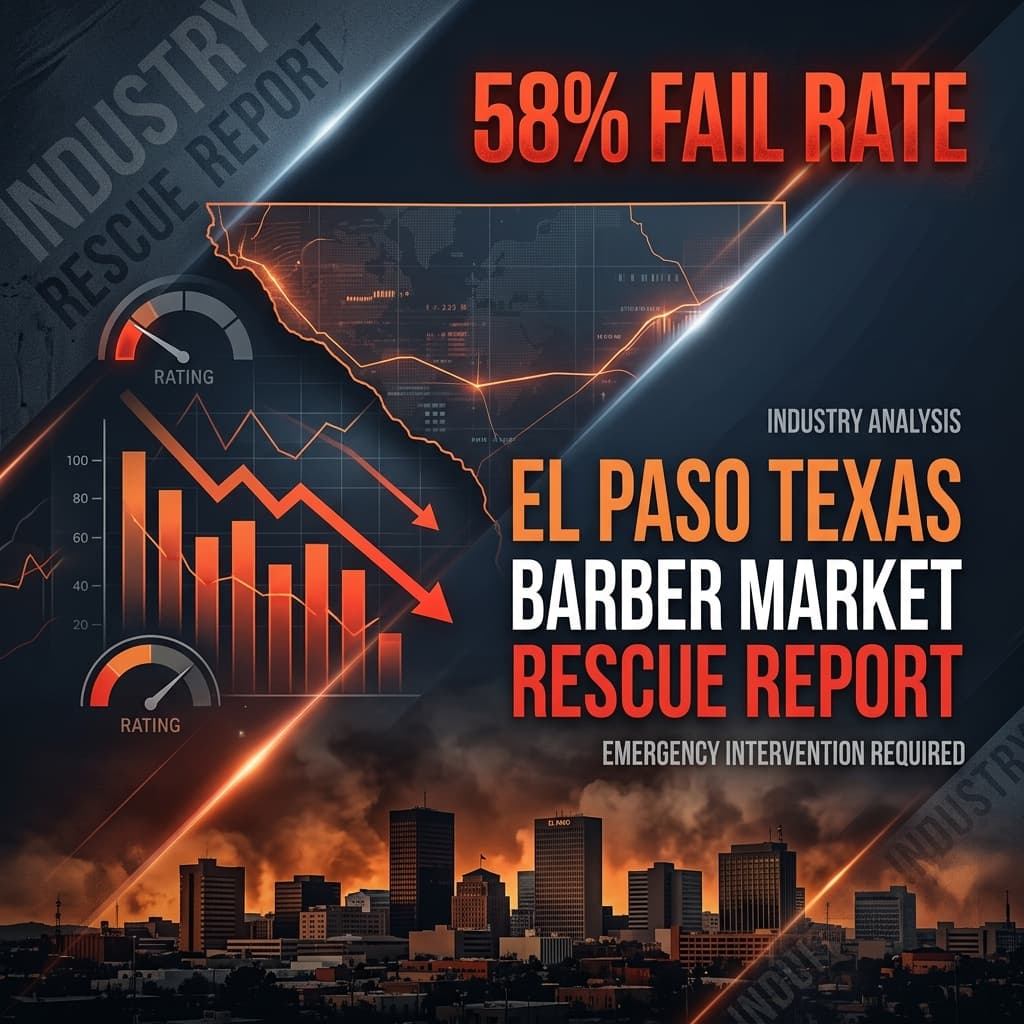
The El Paso barber market exhibits a statistically significant 58.0% aggregate failure rate, driven by a critical disconnect between high testing volume and licensure outcomes.
Immediate deployment of the Barber Exam Prep Pilot Scholarship to provide institutional-grade theory support for students at high-volume programs.
Recovery of regional licensure velocity and stabilization of institutional accreditation for El Paso's core barber education clusters.
Localized ADI-driven exam prep to bridge the gap between classroom hours and PSI theory logic.
The El Paso Barber
Market Rescue Report
A strategic audit of the El Paso barber education cluster, where failing metrics at institutions like Socorro High School and Milan Institute signal a systemic need for theory-first intervention.
Rescue Mission Statement
This report is not designed to criticize El Paso's barber institutions. Instead, it serves as a data-driven "Rescue Map" to identify where students are struggling most. By providing the Barber Exam Prep Pilot Scholarship, we aim to support these schools and their students in overcoming the current licensure bottleneck.
01. The El Paso Data Surge: Statistical Significance
El Paso stands out in the April 2026 TDLR Roster as having the most statistical significance in terms of high testing volume coupled with a critical failure rate. While other cities show high percentages, El Paso's sheer volume makes its 58.0% aggregate fail rate a regional crisis.[1]
Institution Spotlight: Socorro High School
Socorro High School produced the highest absolute number of individual failing grades from a single institution in the provided data, with 24 failing grades out of 41 tests—a 58.5% fail rate. This volume indicates a critical need for theory-aligned prep tools.
The combined failure rate across Socorro HS, El Pipo, Capelli, and Milan El Paso.
24 failures out of 41 tests—the highest volume failure point in the region.
Driven by James Earl Rudder HS and Goldstar Barber Academy.
Barbers Trade School recorded the highest individual failure rate for high-volume programs.
02. The Heatmap: Regional Failure Pockets
Beyond El Paso, critical failure rates are concentrated in specific metropolitan pockets. These "Failure Pockets" highlight that the issue is not limited to one city but is a statewide instructional alignment challenge.
Key Institutions: Next Top Barber Academy, Immaculate Cut Barber Institute
Key Institutions: Modern Barber College (HOU), Cut & Shave Barber & Beauty (SA)
Key Institutions: Texas Fadez Barber College
03. The Title IV Danger Zone: Accreditation at Risk
For every El Paso barber school, the NACCAS 70% written exam threshold is the institutional lifeline. When a school's aggregate pass rate drops below this mark on a quarterly basis, NACCAS issues a Request for Monitoring — the first step toward losing Federal Title IV eligibility.[4]
Without Title IV, the average Texas barber academy loses access to the federal student loan pipeline that funds the majority of enrollment. At a 58.0% fail rate, El Paso's institutions are not just below the threshold — they are operating in the danger zone where accreditation remediation becomes mandatory.
| Scenario | Outcome Path | Accreditation Safety | Student Outcome |
|---|---|---|---|
| Standard TX Curriculum Only | 58% Fail Rate · 90-Day Delay | Probationary Risk | Unlicensed Limbo |
| Generic Flashcard Apps | Inconsistent Results | Marginal Safety | Baseline |
| Barber Exam Prep Scholarship | Target 85%+ Pass Rate | Secure NACCAS Buffer | Licensed in 30 Days |
04. The Rescue Solution: Pilot Scholarship Fund
The primary solution to this data-proven crisis is the Barber Exam Prep Pilot Scholarship. By providing students and schools with El Paso Barber Exam Intelligence Prep™—a localized, ADI-powered practice deck—we bridge the cognitive gap that is currently costing El Paso's workforce millions in delayed wages.
Institutional Grant
Schools receive sponsored access to the Barber Intelligence exam prep deck for high-intent students.
Theory Alignment
Students training on the ADI model master the PSI syntax used in the 75-question theory exam.
Licensure Velocity
Recovering the 60-day licensure delay and stabilizing the school's NACCAS aggregate score.
Apply for the Pilot Scholarship Fund
We are prioritizing El Paso-based students and schools for the initial scholarship cohort. Protect your licensure status and your school's reputation with board-aligned theory intelligence.
View Scholarship Details05. The Institutional Verdict: A Rescue Blueprint
The El Paso barber education cluster is not failing because its students lack talent or its instructors lack skill. The failure is rooted in a systemic gap between classroom preparation and the specific cognitive demands of the PSI written examination. The Barber Exam Prep Pilot Scholarship is the precision instrument designed to close that gap.[2]
Cognitive Gap Mapping
AI identifies the specific PSI theory domains where El Paso students show the highest dissonance.
Exam Syntax Training
Students learn to decode the trap-question logic used by Texas state board PSI proctors.
Licensure Entry
First-time pass rates climb, schools recover NACCAS buffers, and students enter the chair earning.
“El Paso's 58% fail rate is not a talent deficit. It is an informational alignment failure. The Pilot Scholarship is the corrective instrument that converts a failing statistic into a licensed workforce.”
Verified Research: Inner G State Strategy Division (2026).[1]
“Every barber student who fails the written exam is a licensed professional the workforce is waiting for. In El Paso, we are not waiting — we are rescuing.”
For the full statewide context on why this crisis extends beyond El Paso, read our in-depth analysis: The Texas Barber Licensure Crisis: A $15M Institutional Risk Analysis →
Research Methodology & Rigor
This report was generated following the Cognitive Project Management for AI (CPMAI) framework. All data points were synthesized directly from the April 2026 TDLR Texas Barber Written Exam English Pass/Fail Roster — an official government record. Failure rates are calculated from raw pass/fail counts per institution and aggregated by city.
Scenario ROI modeling assumes a Texas baseline weekly commission for Class A Barbers and a 60-to-90 day licensure delay window associated with written exam re-testing cycles. The Barber Exam Prep Pilot Scholarship architecture is built on an Accreditation-First foundation to prioritize institutional NACCAS safety above all other outcomes.
Frequently Asked Questions
Inner G Complete Agency architectures are built explicitly to exceed the governance and ethical constraints defined by these global standard-bearing organizations.

Lamont Evans
|Principal AI Architect & FounderLamont Evans is a certified CPMAI (Cognitive Project Management for AI) professional specialized in architecting sovereign intelligence layers for the wellness and grooming sectors. He focuses on the intersection of agentic workflows and proprietary domain-specific models, ensuring every deployment is institutionally auditable and built for long-term ownership.
Research References
Texas Department of Licensing and Regulation (TDLR) (2026). 04/2026 Texas Barber Written Exam English Pass/Fail Roster. TDLR Official Records. Visit Source
Inner G Complete Agency (2026). Regional Market Analysis: El Paso Barber Education Cluster. Inner G Strategy Division. Visit Source
TDLR Barber & Cosmetology Bulletin (2025). Institutional Performance Metrics & State Standards. Texas Government Records. Visit Source
National Accrediting Commission of Career Arts & Sciences (NACCAS) (2024). Accreditation Safety Thresholds & Federal Funding Compliance. NACCAS.org. Visit Source